

What are Puppymills?

You may not know this, but 98% of all pet-store puppies come from puppy mills¹.
Puppy mills are establishments that breed puppies for sale, typically on an intensive basis and in conditions regarded as inhumane². Different puppymills, sometimes taking the form of a puppy farm, have varying degrees of care (or the lack of, as the case may be) for their dogs.
Female dogs are kept in cramped cages for breeding their entire lives. When the dogs (both female and male) can no longer produce puppies, they are abandoned or killed³.
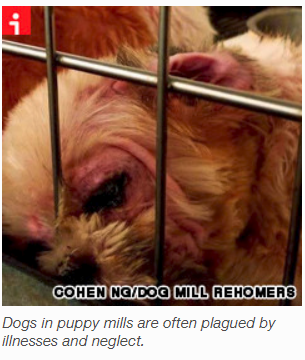
As a result of poor sanitation and a lack of veterinary care, the puppies produced often suffer from a myriad of health problems⁴.
Instead of enjoying the delights of a furry new family member, families who purchase these puppies often find themselves embroiled in expensive and heartbreaking situations.
Information about Puppy Mills⁵
-
Dogs are crammed into tiny squalid cages with their poop and urine, and do not receive veterinary care. They are not taken for walks or allowed to socialise with humans or other dogs.⁶
-
Female dogs are bred repetitively with little or no recovery time, even though it is recommended that an adult dog should only have a litter once a year. They then die from poor health or are abandoned.⁷
-
Male dogs are kept in cages and let out only during mating season.⁸
-
Dogs and their puppies are not screened for genetic diseases.⁹
-
Puppies can be inbred (produced by dogs of the same family – e.g. breeding siblings, or mothers with sons)¹⁰, which is related to ill health and aggression.¹¹
-
Puppies are generally not in good health and are susceptible to various issues such as heart and kidney disease, skin and eye problems, and deafness.¹²
-
Puppies are weaned from their mothers between 4-5 weeks of age and transported to pet shops. ¹³ Puppies ought to remain with their mothers and siblings for socialisation up until 8-12 weeks of age.¹⁴
This ill treatment is continued when the puppies are transported to pet shops to be sold:
-
Puppies are taken away from their mothers and kept in cages during the most formative socialisation age (3-12 weeks).¹⁵
-
They are not exposed to various types of environments, sounds, smells, people, and other dogs to promote socialisation skills, as they are in cages.
-
Improper flooring (wire mesh floors without suitable mats), small cages, and generally unhygienic conditions despite regulations, as shown by an undercover survey by the SPCA¹⁶.
-
Many pet stores are ill equipped with basic animal care knowledge; feeding puppies only 1-2 times a day, allowing them to sleep with their poop and urine, and failing to provide socialisation.¹⁷
-
92% of surveyed pet shops indicated that it is acceptable to keep puppies in cages. 69% said that it is not necessary to spend a lot of time with the puppy.¹⁸
Puppymills in Singapore
Many people are unaware that puppy mills exist in Singapore. They are more commonly known as puppy farms; many which can be found at places far from the public eye, such as Pasir Ris, Kranji or Lim Chu Kang¹⁹.
Despite what these breeders tell prospective buyers, the breeding dogs are kept in terrible conditions, and are forced to produce puppies over and over again.
While the AVS has a code of animal welfare for animal related businesses, which sets out “minimum standards and best practices”, flouting the code is not an offence.
In most instances, an investigation will only be conducted when there has been complaints of a particular business breaching licensing conditions. Hence, many of these businesses continue to thrive without fear of prosecution²⁰ .

2010 Pasir Ris puppy mills case:
75 dogs were abandoned when their owner gave up his business. Many dogs suffered various serious illnesses including tick fever, skin problems and general neglect.
Hip x-rays, blood tests and eye certification cost money and are conveniently ignored by breeders keen to avoid any expenses and only make profits from their commodity.
So while these puppies sell for close to S$1,000 each, most customers do not know they have purchased a ticking time bomb. This is the real cost behind the cruelty of this “cute” puppy, not the hefty price tag.²¹
Anecdote by an owner of an ex-breeding dog:

¹ Hearts United for Animals. Retrieved from www.hua.org
² Acres. Retrieved from https://acres.org.sg/campaigns/current-campaigns/stop-the-cruelty-in-puppy-mills/
³ ASPCA, (2015). Puppy Mills. Retrieved from https://www.aspca.org/animal-cruelty/puppy-mills/closer-look-puppy-mills
⁴ Campaign by Various key animal welfare groups in Singapore. Retrieved from https://sgpuppies.com/about-puppy%c2%a0mills/what-are-puppy-mills/
⁵ Campaign by Various key animal welfare groups in Singapore. Retrieved from https://sgpuppies.com/about-puppy%c2%a0mills/what-are-puppy-mills/
⁶ Tuck Wah, Siew, (2018). If everyone detests puppymills, why do they still exist? Retrieved from https://www.channelnewsasia.com/news/commentary/everyone-finds-puppy-mills-repulsive-why-do-they-still-exist-10314926
⁷ASPCA, (2015). Puppy Mills. Retrieved from https://www.aspca.org/animal-cruelty/puppy-mills/closer-look-puppy-mills
⁸ Hope Dog Rescue, (2011). The Dark Side of the Puppy Trade. Retrieved from http://hopedogrescue.blogspot.com/search?q=breeding
⁹ Ong, Natasya (2010). The 'puppy mills' of Singapore. Retrieved from http://travel.cnn.com/singapore/puppy-mills-pet-store-337803/
¹⁰ PetMD, (n.d.). Problems Common to Purebred Dogs . Retrieved from https://www.petmd.com/dog/care/evr_dg_purebred_dogs_complications
¹¹ The Kennel Club. Retrieved from https://www.thekennelclub.org.uk/health/for-breeders/understanding-canine-genetics/inbreeding-and-health/
¹² SPCA Bulletin 2015. Retrieved from http://www.spca.org.sg/pdf/SPCA%20Bulletin%20Mar%202015.pdf
¹³ Hope Dog Rescue, (2011). The Dark Side of the Puppy Trade. Retrieved from http://hopedogrescue.blogspot.com/search?q=breeding
¹⁴ American Kennel Club. Retrieved from https://www.akc.org/expert-advice/dog-breeding/best-age-send-puppies-to-new-homes/
¹⁵ The Kennel Club, Retrieved from https://www.thekennelclub.org.uk/getting-a-dog-or-puppy/general-advice-about-caring-for-your-new-puppy-or-dog/puppy-socialisation/
¹⁶ SPCA Bulletin 2011. Retrieved from http://www.spca.org.sg/pdf/Bulletin%20jan11.pdf
¹⁷ SPCA Bulletin 2012. Retrieved from http://www.spca.org.sg/pdf/Bulletin%20Oct-Dec%202012.pdf
¹⁸ SPCA Bulletin 2011. Retrieved from http://www.spca.org.sg/pdf/Bulletin%20jan11.pdf
¹⁹ Perropet Singapore, 2018. Is my Puppy From a Pupy Mill? Retrieved from https://www.perropet.com/2018/09/10/puppy-mills-in-singapore-2/
²⁰ Tuck Wah, Siew, (2018). If everyone detests puppymills, why do they still exist? Retrieved from https://www.channelnewsasia.com/news/commentary/everyone-finds-puppy-mills-repulsive-why-do-they-still-exist-10314926
²¹ Ong, Natasya (2010). The 'puppy mills' of Singapore. Retrieved from http://travel.cnn.com/singapore/puppy-mills-pet-store-337803/